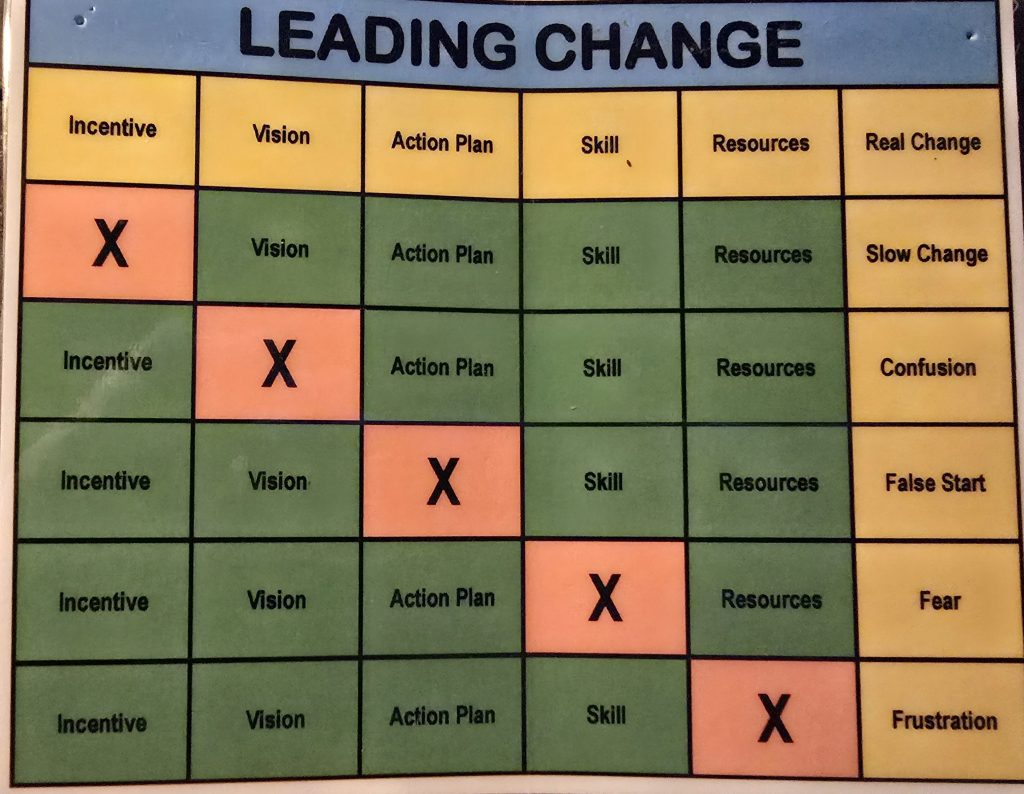
Recently, I came across a card that I received in one of my grad school classes that represented the Lippitt-Knoster Model for Managing Complex Change. Introduced over three decades ago, it is still an applicable guide to help leaders navigate change and identify when key conditions are missing that prevent the change from being successful. As I reviewed the model again and thought about situations I and others have faced when leading change, this matrix was a good way to reflect and consider how to do things differently in the future. Here is an overview of scenarios where a key condition is not in place when a leader is executing change. (Note that I am following the order of the picture at the top of this post. You may see other versions with a different order or synonyms of what is listed here.)
The first condition on my version of the matrix that can derail change if missing is incentives. Any time you bring in something new, team members will immediately ask what’s in it for them (even if they don’t ask it publicly). An important part of change management is letting team members know how this will benefit them or why it’s important for them to be a part of the change. If individuals do not see any value to them or how they can contribute to the change, motivation will tank and while the change may still move forward, it will be at a slower pace. It can also face resistance with some team members believing that there’s no reason to align with the change because it’s not going to make things better for them. Take for example the transition to a new account management system after years of using the same one that was working well. Having trusted peers take early adoption of the system, then serving as champions, may be a path to consider to help share the incentives for others such as reduced administrative burden, increased automation, and better integration with other key systems within the organization. The engagement from champions has to be genuine and authentic, or skeptical team members will see perceptions they interpret as “smoke and mirrors.”
Next, the model shows us that without vision, confusion will abound amongst those involved in the change. As leaders, it is important to clearly communicate your vision for the change with the why behind it. If your team has a vague understanding and their part in it, they will question you and others and will hesitate moving forward. I have experienced situations where I thought I provided the vision for a project or goal, only to find later that those involved were blocked because they did not understand where they fit into the bigger picture. Once I was informed of this and gave clearer definitions, the team was able to understand their role and contribute to the project.
While having a vision established and shared with the team is necessary to lead change, it will go nowhere if you don’t have an action plan. Some teams may get behind their leader that has shared the vision without asking “how do we make this happen?” If those details are not laid out, you’re going to see a lot of false starts executing the change and will have to go back to the drawing board. Even in an agile and accelerated environment, you must call out the steps to make those changes happen. This could be in the form of a process map or simple spreadsheets that show key tasks and milestones along with who is responsible for them. With this in place, it avoids people working in silos or misinterpreting what needs to happen for the change to be successful.
The model then shows that without the right skills – those necessary to operate once the change is in effect – team members may express fear or anxiety. It’s critical to determine the skills needed prior to executing change and identifying where you have gaps. This may require training, bringing other resources in, and prioritizing key tasks to allow things to continue moving forward while team members are ramping up those skills. Implementation of AI in organizations is a great example of this. In my organization, not only was the goal for employees to adopt AI into their daily work, but it was also supported by various learning opportunities to help develop skills. Offerings included webinars that demonstrated how to use tools and hands-on workshops where attendees were given scenarios that they applied AI prompts to get results. There was also a resource page, open office hours, and easily accessible job aids to help everyone apply learning to help improve efficiency and still bring the human element into the AI journey. Equipping the workforce helped to alleviate many concerns people may have had by adopting a technology that for some is very daunting.
The last condition that you see on the matrix is resources. This comes in the form of people, finances, collateral materials, and other identified things needed to support the change. If you go to implement the change and don’t have the right people to contribute, or you aren’t approved for the appropriate funding, frustration will abound and the change may be stalled. I will acknowledge that there are times when you may be limited with the resources that are available to you based on company conditions and decisions made to reduce funding. This does not make the change impossible. In these scenarios, it’s vital to assess what is available to you and how you can move forward even with limited resources. I’m currently involved in a major project where we do not have funding available. It has not blocked us from implementing the change to offer a new solution to our key customer. My leader had the vision to offer an innovative product, shared with us the benefits that it would have to the end user and to us by being part of a big change that would make it easier for our customer to work with us, helped us create the action plan to make it happen and allowed us to determine how the skills of our teams would bring the change to fruition. Along with the resources I just mentioned, we are nearing the launch of this product, and I am excited to see how it will improve the experience of the customers we serve. I hope that this review of the leading change matrix is either a refresher to you, or it gives you some insights to apply the next time you are leading change with your teams. What were some a-ha moments for you? What conditions have you seen make or break a change? Please share in the comments!


