“Remake the world, a little at a time, each in your own corner of the world.”
― Rick Riordan
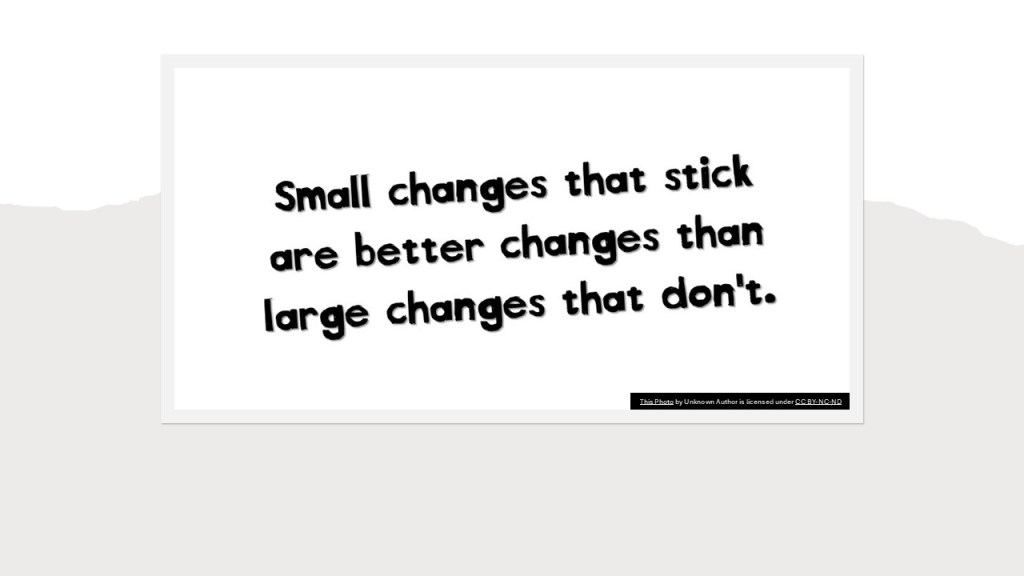
Throughout our lives, many of us look for ways to improve. There are annual resolutions that come and go, enthusiastic commitments where we bite off more than we can chew, and the all or nothing approach to change that for some becomes nothing.
Big change is needed in certain circumstances. Sometimes, that change needs to come sooner than later because of catastrophic consequences that will happen without the change. Other times, while the big change is the ultimate outcome, tackling it with smaller adjustments makes that change more achievable and sustainable.
I’d like to share two examples of where this applies. Habits are one area where incremental changes are often encouraged. In the book Atomic Habits by James Clear, the author emphasizes the importance of making “tiny changes” to better solidify making changes to either start or stop doing something to better oneself. Clear’s own experience recovering from a serious injury required him to make small changes that eventually brought him to recovery.
I am currently in the middle of incremental change as I work to get back into a consistent exercise routine. Based on past attempts, I knew if I tried to go all in right away I’d have limitations that would become my excuse to not exercise. Instead, I started with five minutes a day of a specific exercise. I am currently 10 days in and have increased from five minutes to 10 minutes. I’ve alternated between a few different types of exercise and am committed to building the right resistance and ability to strive towards better health.
Another area that benefits from incremental change is in workplace learning and development. Even with requirements for a new hire to go through training in a defined timeframe, introducing knowledge and tasks in chunks brings better retention compared to immersing the learner in the entire process right away. In environments where you can build on task learning, this approach is valuable. Many Learning and Development teams, including my own, are moving to microlearning courses and continuous learning models to better integrate employees into the workforce. In a Modern Workplace Learning blog post, Jane Hart argues that continuous learning occurs over time, often as part of on-the-job training, and is an element that companies acknowledge is needed. While there may be some formal training that happens, the employee continues to improve as they apply learning to their day-to-day activities and gain new skills along the way.
As the workplace becomes more agile and fast-paced to keep ahead of the competition, leaders and learning teams need to collectively consider bringing this model into their training plans and pair it with mentors and coaches to help guide employees whether they are new to the organization or are looking to gain new skills for the next step in their career.
Looking at these two examples, how have you seen the benefits of incremental change personally or professionally? I’d love to hear about your experiences!


