Engagement and Learning Using Technology

One of my grad school projects involved developing and sharing a perspective of how technology promotes engagement and performance by learners in blended and online settings. Below is a focused literature review from the project.

What are apparently effective strategies for motivating learners in online settings?

            Whether a learner chooses to enroll in an online course or is required to do so, strategies must be implemented to help sustain motivation throughout the duration of the course. Because learners are motivated to engage in learning for different reasons, educators should consider having multiple strategies in place to address a variety of motivational factors. Studies of motivation strategies in face-to-face environments have examined how learners demonstrate extrinsic and intrinsic motivation and the part that instructors play in implementing motivational strategies in the classroom (Newby, 1991). Keller’s ARCS (Attention, Relevance, Confidence, and Satisfaction) model has also been applied to classroom observations to identify if teachers focus more on specific or various motivation strategies within the classroom setting (Newby, 1991). Educators have also looked for opportunities to improve motivation for non-English speaking students that struggle learning the English language (Alshenqeeti, 2018). It is known that “learners learn differently and are motivated by different things” (Alshenqeeti, 2018) in face-to-face settings, and this thought can also be considered when looking at effective strategies for motivating learners in online settings.

            When comparing motivation strategies between face-to-face and online learning environments, studies infer online students appear to be less motivated but are found to achieve higher grades than face-to-face learners (Stark, 2019). These learners often choose to participate in online courses based on increased flexibility and convenience of schedule (Stark, 2019). Though some studies indicate higher dropout rates in online courses, others report high success rates that suggest the ability for online students to acclimate themselves to online learning (Stark, 2019).  Stark’s study using the Motivated Strategies for Learning Questionnaire (MSLQ) identified lower levels of intrinsic and extrinsic motivation for students in online courses (Stark, 2019). Even so, the same learners expressed that they had the ability to succeed in online learning (Stark, 2019). What supported the motivation of online learners in this study was their perceptions of being able to have more control over their learning experience as well as reduced test anxiety (Stark, 2019). In addition, past studies showed that having prior online learning experience could influence motivation and learning approaches for future online courses (Stark, 2019). Tapping into prior experience may be helpful to online instructors to increase motivation and engagement in future learners that enroll in their course.

            While over 30 years old, Keller’s model that is “the conceptual foundation of the attention, confidence, satisfaction (ARCS) model of motivation” (Milman & Wessmiller, 2016) is studied in relation to online learning. This model includes four categories with examples of motivation strategies that can be incorporated into online courses. The component of attention looks at provoking as well as continuing to keep learner’s attention (Milman & Wessmiller, 2016). For online learning, this can be done using media such as video, graphic images, and even comic strips to gain attention (Milman & Wessmiller, 2016). The relevance component is one that answers the question “why do I need to learn this topic?” (Milman & Wessmiller, 2016). It looks at finding ways to meet personal and professional goals of learners and can be implemented by incorporating current event topics into learning (Milman & Wessmiller, 2016). As learners navigate through an online course, confidence is the next component to instill to give them the assurance that they can achieve the learning outcomes of an online course (Milman & Wessmiller, 2016). While this can be a challenge in online settings, videos or emails can be developed with encouraging messages to boost learner confidence (Milman & Wessmiller, 2016). Satisfaction, the last component, can be immediately experienced through online learning (Milman & Wessmiller, 2016). The ability to provide prompt feedback in the form of grades and assessment results is one way to provide more timely satisfaction (Milman & Wessmiller, 2016). Another method is offering the opportunity for immediate application of learning using a discussion board or wiki for showcasing student work (Milman & Wessmiller, 2016).

            Gamification is another strategy that can be implemented in the context of the flipped classroom, which is a blended learning model (Matsumoto, 2016). Effective gamification continues to be a popular learning tool that includes the following components: a clear and succinct tutorial, tasks that are learner-driven, a well-arranged platform, and motivation-inspiring and prompt feedback (Matsumoto, 2016). By incorporating elements of game design in non-game settings, gamification allows learners to apply game-like actions to real-world scenarios for problem-solving opportunities (Matsumoto, 2016). For example, first year high school English as Foreign Language students participated in an e-Learning course that incorporated gamification (Matsumoto, 2016). During the lecture portions of the course, students watched as in-game characters presented the lesson, then completed a task that was complimented by the character when complete (Matsumoto, 2016). The home page of the course allowed learners to track task completions, open tasks, and achievement rankings (Matsumoto, 2016). Data results showed that students grades improved post-learning (Matsumoto, 2016).

            Motivation strategies also aided in boosting learner motivation during the COVID-19 pandemic. While buildings were required to close, it was believed that learning and teaching did not have to cease during the closure (Nguyen, 2021). An example of this occurred at a Vietnamese university using several technology applications to teach remotely (Nguyen, 2021). Researchers acknowledge that barriers that exist in online learning have worried educators and those researching educational technology (Nguyen, 2021). These barriers include lack of technology experience and support as well as preferences and beliefs (Nguyen, 2021). The study sought to initially identify barriers perceived by students that transitioned to online learning because of the pandemic as well as study the effects of implementing motivation-boosting strategies to learning activities including audio and video clips, pointing learners to websites and social media tools, text chat activities, and the use of Zoom or Skype for video calls (Nguyen, 2021). Adding the alternate methods showed in the results to boost motivation and led to higher performance (Nguyen, 2021).

            While studies show that online learners tend to be less motivated yet often are still successful in performance, my research will look deeper into the areas of relevance, self-regulation, and how technology can gain and sustain motivation. Studies also show dropout rates are higher among online learners compared to those that opt for face-to-face environments. That means that for some there have been experiences where the learner is no longer motivated to continue in an online course. I would like to further study those reasons to identify if missing motivation strategies would have made a difference in dropout rates for particular courses. With a focus on workplace learning, research can be done on the role of the virtual trainer, a comparison between voluntary and required online learning, and the motivational needs of employees that seek out online training.

What are your thoughts on online learning? What online courses have you found most engaging and helpful in your development journeys? Where are there still opportunities to improve online learning, whether in academia or the workplace? Is there still a value in live, in-person learning? Why or why not?

References

Alshenqeeti, H. (2018). Motivation and Foreign Language Learning: Exploring the Rise of Motivation Strategies in the EFL Classroom. International Journal of Applied Linguistics & English Literature, 7(7), 1–8. https://doi.org/10.7575/aiac.ijalel.v.7n.7p.1

Matsumoto, T. (2016). Motivation Strategy Using Gamification. Creative Education, 7(10), 1480–1485. https://doi.org/10.4236/ce.2016.710153

Milman, N. B., & Wessmiller, J. (2016). Motivating the online learner using Keller’s ARCS model. (attention, relevance, confidence, satisfaction). Distance Learning (Greenwich, Conn.), 13(2), 67–.

Newby, T. J. (1991). Classroom Motivation: Strategies of First-Year Teachers. Journal of Educational Psychology, 83(2), 195–200. https://doi.org/10.1037/0022-0663.83.2.195

Nguyen, H.-T. T. (2021). Boosting Motivation to Help Students to Overcome Online Learning Barriers in Covid-19 Pandemic: A Case study. International Journal of Interactive Mobile Technologies, 15(10), 4–20. https://doi.org/10.3991/ijim.v15i10.20319 Stark, E. (2019). Examining the Role of Motivation and Learning Strategies in Student Success in Online Versus Face-to-Face Courses. Journal of Asynchronous Learning Networks JALN, 23(3), 234–. https://doi.org/10.24059/olj.v23i3.1556

Doctoral Journey part 5 – Wrap up and defense

Continuing the story of my dissertation journey, I’m nearing the end of the experience. Taking the information from my qualitative and quantitative data, I finished writing two of my three papers. My third paper took a different approach in the form of a thought paper. Also known as a position paper, it allowed me to share my views of my topic with research to support. It also brought a call to action to those that make decisions related to supporting remote and hybrid workers. Once my papers were completed, it was time to prepare for the culmination of my doctoral program – the dissertation defense.

The defense was a presentation of my research, summarizing the three artifacts I wrote and sharing the importance of the results. The group that would hear my defense was my dissertation committee, consisting of my advisor and two faculty members that I had asked to support me in the journey. I could not share every little detail of my papers, so I had to choose the key points with guidance from my advisor. My presentation included background on my topic, the purpose of my research, the methods used in my research, who would benefit from my findings, and a summary of each artifact. It was still a lot of information to present in 25 minutes, so I had to be as precise as possible. After creating my presentation, I reviewed it with my advisor and practiced ensuring I was within my time limits and prepared for any questions the committee may ask me.

Finally, the day I’d been working up to had arrived – dissertation defense day. I got on a Zoom call and presented my dissertation summary. After the presentation, I was asked a few questions to clarify points I had shared in my research. Then, I was sent to a virtual waiting room while the committee discussed my presentation. After many minutes, they brought me back to the group and gave me the news that I had passed my dissertation! It was a very emotional moment for me as I reached the moment of celebration and accomplishment, remembering all that I experienced along the way both academically and personally.

Following my defense, I finalized my paper to submit to the offices of the graduate school and prepared for commencement. On May 3, 2024 (which happened to be my 48th Birthday), I walked onto the stage and received my doctoral hood as did one of the friends I had made in my cohort. My mom was able to join me for the celebration, which was a great honor to have her with me.

Over one year later, I still reflect on the journey and am on the next steps of my goal to get my articles published. For this reason, I am not sharing details of my research currently. I hope to share the story of that journey in the months ahead. In the meantime, my future posts will focus on learning and development and leadership related topics.

I hope that this series of posts gave you insight into the doctoral program experience. If you are considering this path, I’m happy to answer questions to help you with your decision. Even if you are not looking to get a degree, feel free to share questions and comments you may have related to my experience.

Doctoral Journey part 4 – Data Analysis

If you’ve been following the doctoral journey posts, you have learned the experiences I had to prepare for my dissertation writing, including the collection of data. In this entry, I will share how I evaluated and analyzed the data collected from my surveys in preparation for writing those sections of my dissertation articles.

My survey had two purposes. First, many of the questions contributed to my quantitative study with respondents sharing their perceptions of organizational support by scoring Likert-based questions. The remaining questions allowed for open-ended responses that allowed respondents to share their first-hand experiences receiving organizational support in their jobs. That data contributed to my qualitative study.

For my quantitative study, I extracted the Qualtrics results to an Excel file. Portions of  that data were loaded into SPSS, a software tool that allows for multiple types of data analysis. I chose to provide insights through a descriptive analysis that explored my research questions and inferential data analysis that sought to determine if key characteristics affected an individual’s perceptions of organizational support for onboarding and development as a remote worker. The descriptive analysis allowed me to see the overall responses to each survey question collectively and identify if responses were more positive, negative, or neutral. The inferential analysis allowed me to take those same questions and dig deeper into the data by seeing if the answers changed based on someone’s role, gender, and their competency levels related to technology use. I felt that SPSS was a helpful tool in my data analysis and offered several ways to represent the data graphically which gave me a few choices for how I wanted my results represented in my dissertation.

The data for my qualitative study consisted of verbal responses to the open-ended questions included in the Qualtrics survey. To analyze this data, I used an online tool called Delve. It allows you to load your qualitative responses and apply codes to the text to identify trends. The tool also has AI functionality to simplify the process, but I did not use this in my analysis. For each code, I included definitions to help guide coding. After the results were coded, I had a list to review and determined which codes had more responses. This brought out trends and themes where I could share commonalities in the experiences of the respondents based on their narrative. In addition, I was able to create a transcript of the coding that I added to the appendix of my qualitative paper. This data helps tell the story of the experiences a group of remote workers had in getting the support they needed from their company, leaders, and peers.

With the data analyzed, I was ready to move forward with the completion of my dissertation and get closer to earning my doctoral degree. In my next post, I’ll share about the finishing steps of completing my dissertation writing and preparing for my defense.

Which type of data do you find more useful when you are researching or hearing a presentation with data? Share your comments!

Doctoral Journey part 3 – the dissertation experience begins

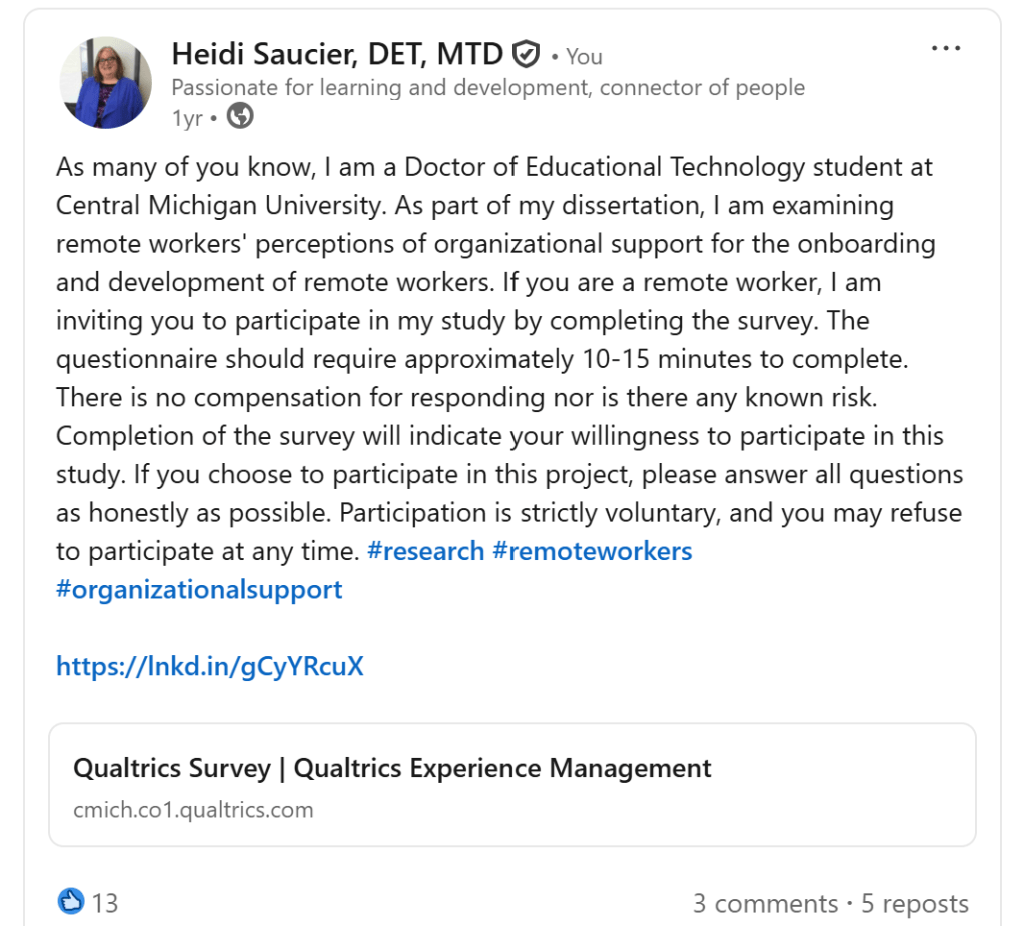
The time finally came for me to start my dissertation. One of the first things I had to do was get approval to do my research. Because my study included human subjects, this involved submitting a request to the university’s Institutional Review Board, or IRB.  The request included the goals of my study, a description of the sample, and how I would gather data. The group reviews requests and determines if the study is ethical and follows the university’s policies. My original plan was to ask volunteers to complete an online survey for my quantitative paper, then ask for leaders of remote or hybrid teams to participate in interviews about their experiences for my qualitative paper. I received feedback from the IRB looking for clarification and additional things I would need to do for the interviews, which posed some unexpected challenges. Due to some deadlines I needed to meet, I discussed alternative options with my adviser. We agreed that I could still do a qualitative study using open-ended questions in the survey I was creating for my quantitative research. I adjusted my IRB submission and resubmitted it to the board. Shortly after that submission, I received an approval. I could now move forward with sending out my survey and collecting data.

There are various types of samples that can be used for research. There’s random sampling, where individuals are selected unbiasedly like a lottery drawing. Convenience sampling allows the researcher to choose individuals based on their ability to participate and tend to be people that are more easily accessible. Another one of the methods is snowball sampling, which involves people referring others to participate. I chose a convenience sample by soliciting volunteers to complete my survey. I posted on Facebook, LinkedIn, and X asking for people to participate. In each post, there was a link to the survey that included a letter explaining the survey and confirming their participation and that no harm would come to their physical or mental health. I gave participants three weeks to complete the survey. While I was waiting for my data to come in, I worked on literature reviews and sections of my articles that did not rely on my research results. I was excited to see the responses that individuals with experience working from home had and how they related to prior research and my research questions.

Next time, I will share how I evaluated my data and used it to move forward with the writing of two of my three artifacts.

I hope you are enjoying hearing about this journey. I’d love to hear any a-ha moments you’ve had along the way!

Doctoral Journey part 2 – preparing for the dissertation

Last time, I shared highlights of my classroom experiences during my doctoral journey that helped prepare me for my dissertation. Before my research could begin, I had to present my case to the members of my dissertation committee and get their approval. What does that mean?

First, let me explain the dissertation committee. This group was comprised of my program advisor and two faculty members that provided additional insights and support regarding my research. One was well-versed in APA requirements for writing and would be able to ensure I was citing prior research appropriately to prepare me for future publication.

Before I could go before the committee, I had to prepare my dissertation defense. This was a presentation of why I felt there was a need for my research focus, what my research would include, and the timeline for completing my dissertation. I searched for relevant journal articles that provided findings on organizational support and remote workers to support the background of my study and help formulate literature reviews that would correlate with my dissertation artifacts. I created research questions that I would explore through the survey I would later create and identified the research methods I would use for my dissertation.

Part of my proposal also tasked me with considering publications that I would submit each artifact to post-graduation. That allowed me to explore potential journals that would be most appropriate to share my research with.

Once all of this was completed, I presented my proposal to my dissertation committee. This gave the committee the chance to ask questions and clarify what my goals were and the path I wanted to go down for my research. After my presentation, I was excited to learn that my proposal was approved. I was now ready to begin the research path and gather the data I needed for my dissertation.

In my next post, I will share my dissertation adventures and what I learned during that time.

For anyone else that has gone down this path, what were your experiences preparing to start your research? Did  you have to make any adjustments to your dissertation plan? I’d love to hear about it!