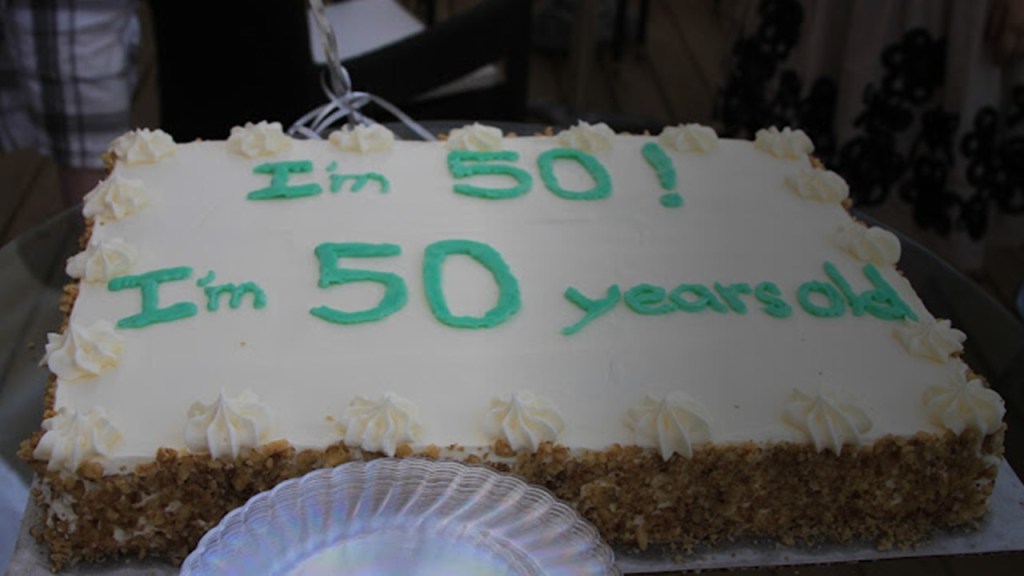
Turning 50 – reflecting on five decades part 1

Yesterday, I hit a major milestone. I’ve now been on this earth for five decades. Looking back as I’ve approached this date, so much has happened that brings different kinds of memories. For the next several posts, I have decided to share what has happened in the world from a history and leadership perspective in the last 50 years as well as insights from my own life and development journey. To start, I’ll share about the first twenty years.

1976-1985

I was born the year of America’s bicentennial, so that was big news in the months following my birth. The number one song the day I was born was “Welcome Back” by John Sebastian. Fondly remembered as the theme to Welcome Back, Kotter, it was still too early to know the extent of fame that John Travolta would see in his acting career. The nation was 200 years in, with technology advancing and political conflicts continuing. Those first 10 years of my life saw me living in two cities and attending two different elementary schools. I made my first communion, learned to love reading and some math, and enjoyed many great trips with family. That time also saw the start of Apple, continued Cold War tensions that included the Soviets invading Afghanistan, advancements in space exploration with Columbia launching as the first reusable shuttle, the start of MTV (I miss the 24/7 videos), and efforts like Live Aid where musicians led the way to raise awareness and money to help countries struggling with famine.

From a leadership development perspective, some of the most popular professional focused books in that decade included James Macgregor Burns’ Leadership, which highlighted transactional and transformational leadership and The One Minute Manager, Ken Blanchard and Spencer Johnson’s very popular book that shared techniques to boost productivity and empower employees. Leaders during that decade included three U.S. Presidents – Ford, Carter, and Reagan; four Soviet leaders including Leonoid Brezhnev and Mikhail Gorbachev; and the beginning of Margaret Thatcher’s 11-year journey as the first female Prime Minister of the UK. I really didn’t have any specific leadership opportunities that I recall from that young age, but they would certainly emerge as I started the next decade of my life.

1986-1995

When I turned 10, we were getting closer to the end of the Cold War. Robert Palmer’s “Addicted to Love” was the number one song on the radio, and Top Gun was the top grossing movie of 1986. The time went by quickly as I grew to love music and was involved in band, choir, and theatre during many of those years. I went on some amazing band trips which included Saint Louis, Virginia Beach, and Chicago. I sang in multiple choir concerts and competitions and had a role behind the scenes or on stage for two plays and three musicals. I also managed to visit Washington, D.C. three times in that decade. First for our eighth-grade trip, two years later on a band trip, and two years after that at a high school journalism conference. I graduated from high school during this decade of life and started my first year of college. While I did not fare well my freshman year, I gained some valuable lessons that took me to an improved academic experience at other schools in future years. Two tragedies marked the beginning of this decade with the Challenger explosion and the Chernobyl incident. There was also the controversial discovery that became known as the Iran-Contra Affair. The second decade of my life saw the fall of the Berlin Wall along with the reunification of Germany and the end of the USSR, the launch of the World Wide Web, the Gulf War, the Oklahoma City bombing, the O.J. car chase and trial, the rise of grunge music, the death of Kurt Cobain, and the beginnings of the Foo Fighters (some of you knew I was going to find a way to mention them!).

While I was navigating all levels of school from elementary to my first year of college, there was a lot of buzz from a leadership development perspective. Mentioned in my last post, The 7 Habits of Highly Effective People (which I now own thanks to a friend’s generous birthday gift!) was published within those ten years along with Tony Robbins’ Awaken the Giant Within and Unlimited Power which center on controlling thoughts and emotions as well as developing peak performance. Leaders during that decade included Reagan and two more U.S. Presidents – George H.W. Bush and Bill Clinton; the end of Mikhail Gorbachev’s leading of Russia followed by Boris Yeltsin; and the conclusion of Margaret Thatcher’s role as Prime Minister followed by John Major. In the second half of this decade, I began to find ways to lead. I oversaw our high school band uniform coordination, making sure inventory was updated and that each band member had the right sizes and pieces for marching band. I also had the chance to coordinate volunteers for our school’s blood drive, a small thing that helped lay the foundation for another volunteer leader opportunity later in life.  

I will continue the decades in my next post as I reflect on these past 50 years both personally, professionally, and historically. What are things you recall that shaped you over the decades of your life? I’d love to learn about them! Feel free to share in the comments.

Doing the impossible

I hope that the questions in the past posts have allowed you to reflect on your life journey and given you some new insights. On to the next question!

What was something that seemed impossible – but you did it anyway?

For most of us, we’ve had times in our life where we faced the decision to move forward with something we didn’t think we were capable of or thought would be an uphill battle to reach the finish line. At that moment, we could have decided that it was ok not to move in that direction. We had every right to do so. Instead we chose to slay the dragon, overcome the giant – whatever you want to call it – and do what it took to achieve that goal.

I recall a few of these moments. Some changed my perspective. Others taught me the importance of perseverance and resilience. Not all were major events. One instance was making a simple choice to stop eating food after 9 p.m. I had a habit of wanting just one more snack before bed, which is not a healthy practice. As I’ve been exploring ways to make better choices and lose weight, I saw repeatedly that late night eating has a significant impact on our metabolism. I made the decision to put this into practice at the first of the year. I was sure I’d cave and convince myself that I needed just one more thing to eat, and that hunger pangs would constantly taunt me. Even still, I put reminders on my phone and made a conscious effort to make 9 p.m. the cutoff point. I’m happy to share that I have only had one moment where I ate something past that time and overall have not had any major cravings. While it was a small decision, I know it will have positive effects on my overall health goals.

Another example is on a professional level. Recently, I needed to support the design of a microlearning course to address a learning gap. While I am skilled to lead an amazing team that produces quality training courses, I will be the first to admit that I am not a rockstar instructional designer. At the same time, I can create simple courses and navigate through key instructional design tools. I was nervous to take on this project but knew it was necessary to help reduce the errors that our core audience was making in a particular area. The pre-work was the easier part, identifying the objectives and creating the storyboard and script for the lesson. Once I completed that and received approval from stakeholders and subject matter experts, I started the challenging part for me – using the design software. It was a combination of Vyond and Adobe Captivate, two tools that I was familiar with. I consider myself to be between an advanced beginner and competent user, having created videos in the past. I began putting the work together then asked my employee, who uses the tool regularly, for guidance on complex tasks. He was happy to help and gave honest feedback that helped me make key revisions and learn new ways to use Vyond. This led to a successfully designed course that was published on training site for our learning audience to access.

These two examples helped strengthen my leadership skills. How? First, making healthier choices brings me the energy I need to lead. If I’m fatigued or am dealing with health conditions that take me away from work, I risk not being an effective leader. In the second example, I was willing to jump in and ask for help to ensure I was supporting the needs of our team. Leaders should not be afraid to ask others, including their own team members, for their expertise to help them with decisions or key tasks. Your employees can be critical resources that help you build stronger teams. With that in mind, there’s no shame in leaders to ask their employees for support. What are things that seemed impossible for you, but you moved forward in completing the task or goal? Share in the comments!

Energy Givers and Drainers

We’re on to the next of the reflection questions I’ve been sharing.

What gives you energy – and what drains it? This has been a discovery over time that continues to help me find balance not only as a leader, but in all aspects of life. I’ve found for myself that some of my energy givers and drainers have slight similarities and have factors that are key to when certain things bring energy and when they take it away.

One area has to do with interactions with others. When I am involved in small group and one on one conversations, I gain energy during the interaction. I enjoy learning about others and hearing their experiences and insights on various topics. When it’s all done, I have to regroup and reenergize. At the same time, being in large groups and engaging in crowd events will quickly drain energy from me (unless it’s a Foo Fighters concert – that’s one of the rare times I find a balance of energy!). I’ve learned to focus much of my time on smaller interactions. When I am in larger groups, I prepare for the experience then decompress at home as soon as I can!

Learning also brings me a lot of energy. I am truly a learning nerd, always looking for new topics and experiences that bring growth. Whether it’s discovering a new recipe, watching a video on nutrition, looking up steps to use a particular software program, reading an insightful book, or exploring a variety of subjects, I come out excited and encouraged about what I have learned.

On the other hand, an area that is known to drain energy in my world is struggling with change. While able to adapt to change in many scenarios, there are times when I am hesitant to move forward with something new. If faced with a situation that I do not have experience with or feel that there’s not a reason to change because the current circumstances are working fine, my stubborn Taurus nature may flare up and I may first dig my heels in the ground. When this happens, I become exhausted fighting to keep things the way that they are while knowing the change is beneficial to my life. This has occurred in personal, professional, family, and other areas. How have I handled this? In many cases, I take the time to pause and review the whole picture related to the change. From there, as a friend and coworker recently coined, I become comfortable with being uncomfortable. When I take this approach, it may not always be easy but at the same time I persevere and keep moving in the direction necessary to navigate through that change.

Coming to learn some of these contributors to gaining or losing energy, I’ve realized an important lesson. Being intentional to invest my time in the energy givers and being mindful when energy drainers are creeping into my life allows me to change course and point myself back to what energizes me. Where do you find you gain the most energy? What tries to take that energy away from you? Share in the comments!

Looking back 14 years – part 3

Over the last few posts, I’ve been reflecting on the lessons learned over my 14-year career at the company I currently work at. I’m wrapping up that series today by sharing with you the last two that have made a difference and helped me continue down the path of growth as a leader and all-around as a person.

  1. Be willing to take risks
    • If you needed a spokesperson for being risk adverse, I’d probably be at the top of the list. Over the years, I’ve learned that risk is necessary for growth. Some of the biggest risks I have taken led to new doors and successes that I never would have known if I had avoided the risk. This included entering a doctoral program where statistics was not my forte. I was grateful for a professor that took the time and provided tools and videos to help us through analyzing quantitative data. This was a key factor in being able to successfully perform quantitative research as part of my dissertation. When I first became a manager at my company, I moved to an area that I was not as familiar with. Not only was I being stretched as a new leader and the responsibilities it entailed, but I was also being stretched to better understand the audience I was tasked with developing training for. I implemented tactics I had used on other training teams to learn about the audience and worked with stakeholders to uncover their learning needs. These are just a few examples, but ones where had I decided the risk was not worth it, I would not be where I am at in my career journey.
  2. Never stop learning
    • Those that know me shouldn’t be surprised that this is on the list. As a learning nerd, I am always looking for new knowledge. Whether it’s reading a book, watching a video, engaging in a conversation, or taking some sort of class, I crave the chance to learn more every day. There are many quotes out there that reference the importance of learning. One of my favorites is from Jack Nicholson, who said “The minute you’re not learning I believe you’re dead.” A bit dark, but he’s right. Learning should encompass every moment of our lives. In the last year, here are some things I’ve learned:
      • How to use SecureGPT
      • How to create scene changes in a video software we use for learning
      • My son is amazing at math – he most likely gets that from his dad!
      • Having mentors is important
      • Adversity is inevitable – it’s how you respond to it that determines what happens next

I hope that the lessons shared were insightful and helped you reflect on your own career journey. In the next post, I’ll share how I’ve identified goals for 2026 and new ways I’m holding myself accountable. I’d still like to hear the reflections from your journey. Share in the comments!

Leadership lessons all around us

I’m changing gears and sharing something that was an a-ha moment for me last week. I will get back to more on balance in a future post.

During a conversation with one of my mentors, she shared a leadership lesson she encountered while on vacation. It was a special nugget that gave her some perspective on things she would like to do differently as a leader. When I heard the story, it gave me things to consider. But that’s not the point that I’m sharing today.

All around us, there are stories waiting to be revealed. Lessons in the ordinary that want to teach us about leadership and are not part of our day-to-day work. In my master’s program, I took a Team Development course. One of the group projects was to analyze a television show and identify the leadership dynamics of the characters. My group selected the show “Bones,” the 2005-2017 drama series featuring the adventures of forensic anthropologist Dr. Temperence Brennan and FBI Special Agent Seely Booth as they investigated potential murders. Watching select episodes, we identified team dynamics and how the two interacted with each other and members of the forensics team. These stories, while fictional, offered comparisons of best practices and things to avoid when working with a team. This is one of many examples where television and movies can teach us about leadership, working in teams, and other important life lessons.

Nature can also teach us leadership. In the brief inspirational video, “Wisdom of Wolves: Leadership Lessons from Nature” by Simple Truths, quotes and reflective statements uncover how observations of wolves and their packs demonstrate patience, communication, and loyalty along with other characteristics that are key to leading others. The insights on communication stood out strongest to me. Just as wolves use different forms of communication among their packs to be successful, humans also have various communication methods that can be strategically used to ensure teams and individuals adequately receive information and direction to successfully complete tasks and contribute to the bigger picture of team and company goals.     

Sports is another area where some often draw leadership examples from. One of my favorite quotes is Wayne Gretzky’s “You miss 100% of the shots you don’t take.” I’ve applied this in sales training and in my own professional development. From a sales perspective, the quote can motivate salespeople to take every opportunity to close a sale. From a professional development perspective, this quote has challenged me to look at new opportunities to grow through stretch opportunities and leadership challenges. If I don’t, I may not get that shot that could help me get to the next level of my career journey. Where have you found leadership lessons in the ordinary? How have they made a difference in your personal and professional development? I’d love to hear about it in the comments!