Doctoral Journey part 5 – Wrap up and defense

Continuing the story of my dissertation journey, I’m nearing the end of the experience. Taking the information from my qualitative and quantitative data, I finished writing two of my three papers. My third paper took a different approach in the form of a thought paper. Also known as a position paper, it allowed me to share my views of my topic with research to support. It also brought a call to action to those that make decisions related to supporting remote and hybrid workers. Once my papers were completed, it was time to prepare for the culmination of my doctoral program – the dissertation defense.

The defense was a presentation of my research, summarizing the three artifacts I wrote and sharing the importance of the results. The group that would hear my defense was my dissertation committee, consisting of my advisor and two faculty members that I had asked to support me in the journey. I could not share every little detail of my papers, so I had to choose the key points with guidance from my advisor. My presentation included background on my topic, the purpose of my research, the methods used in my research, who would benefit from my findings, and a summary of each artifact. It was still a lot of information to present in 25 minutes, so I had to be as precise as possible. After creating my presentation, I reviewed it with my advisor and practiced ensuring I was within my time limits and prepared for any questions the committee may ask me.

Finally, the day I’d been working up to had arrived – dissertation defense day. I got on a Zoom call and presented my dissertation summary. After the presentation, I was asked a few questions to clarify points I had shared in my research. Then, I was sent to a virtual waiting room while the committee discussed my presentation. After many minutes, they brought me back to the group and gave me the news that I had passed my dissertation! It was a very emotional moment for me as I reached the moment of celebration and accomplishment, remembering all that I experienced along the way both academically and personally.

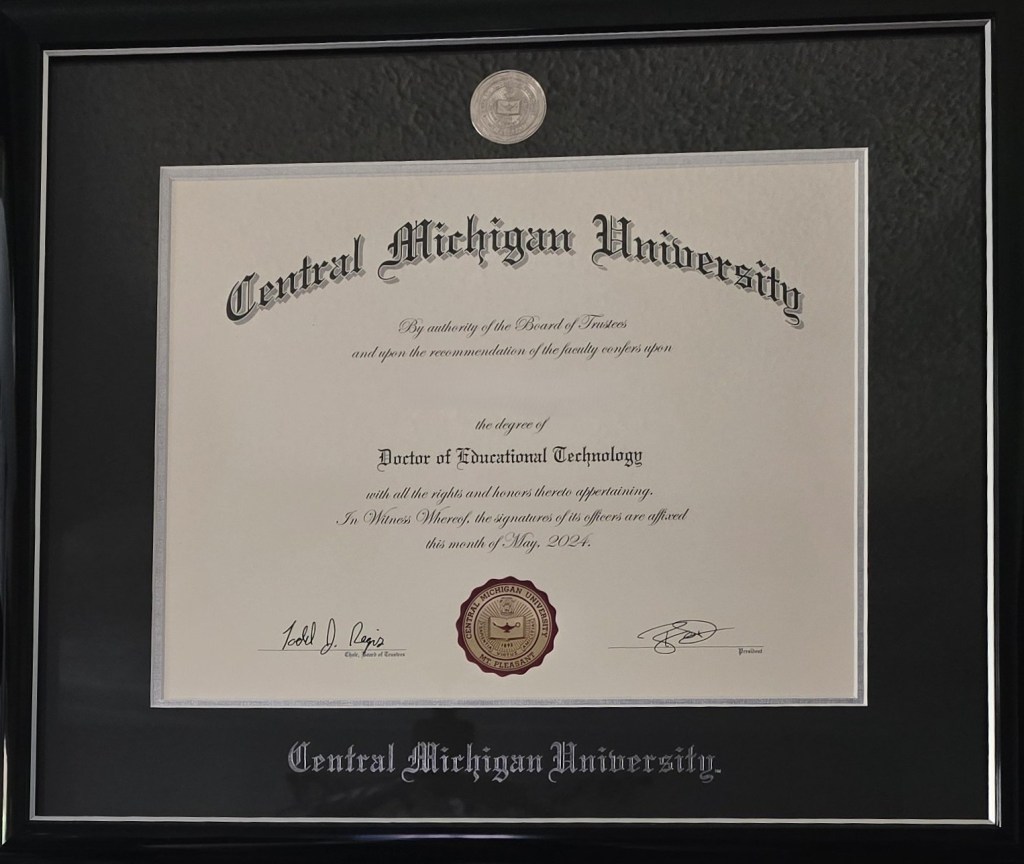
Following my defense, I finalized my paper to submit to the offices of the graduate school and prepared for commencement. On May 3, 2024 (which happened to be my 48th Birthday), I walked onto the stage and received my doctoral hood as did one of the friends I had made in my cohort. My mom was able to join me for the celebration, which was a great honor to have her with me.

Over one year later, I still reflect on the journey and am on the next steps of my goal to get my articles published. For this reason, I am not sharing details of my research currently. I hope to share the story of that journey in the months ahead. In the meantime, my future posts will focus on learning and development and leadership related topics.

I hope that this series of posts gave you insight into the doctoral program experience. If you are considering this path, I’m happy to answer questions to help you with your decision. Even if you are not looking to get a degree, feel free to share questions and comments you may have related to my experience.

Doctoral Journey part 4 – Data Analysis

If you’ve been following the doctoral journey posts, you have learned the experiences I had to prepare for my dissertation writing, including the collection of data. In this entry, I will share how I evaluated and analyzed the data collected from my surveys in preparation for writing those sections of my dissertation articles.

My survey had two purposes. First, many of the questions contributed to my quantitative study with respondents sharing their perceptions of organizational support by scoring Likert-based questions. The remaining questions allowed for open-ended responses that allowed respondents to share their first-hand experiences receiving organizational support in their jobs. That data contributed to my qualitative study.

For my quantitative study, I extracted the Qualtrics results to an Excel file. Portions of  that data were loaded into SPSS, a software tool that allows for multiple types of data analysis. I chose to provide insights through a descriptive analysis that explored my research questions and inferential data analysis that sought to determine if key characteristics affected an individual’s perceptions of organizational support for onboarding and development as a remote worker. The descriptive analysis allowed me to see the overall responses to each survey question collectively and identify if responses were more positive, negative, or neutral. The inferential analysis allowed me to take those same questions and dig deeper into the data by seeing if the answers changed based on someone’s role, gender, and their competency levels related to technology use. I felt that SPSS was a helpful tool in my data analysis and offered several ways to represent the data graphically which gave me a few choices for how I wanted my results represented in my dissertation.

The data for my qualitative study consisted of verbal responses to the open-ended questions included in the Qualtrics survey. To analyze this data, I used an online tool called Delve. It allows you to load your qualitative responses and apply codes to the text to identify trends. The tool also has AI functionality to simplify the process, but I did not use this in my analysis. For each code, I included definitions to help guide coding. After the results were coded, I had a list to review and determined which codes had more responses. This brought out trends and themes where I could share commonalities in the experiences of the respondents based on their narrative. In addition, I was able to create a transcript of the coding that I added to the appendix of my qualitative paper. This data helps tell the story of the experiences a group of remote workers had in getting the support they needed from their company, leaders, and peers.

With the data analyzed, I was ready to move forward with the completion of my dissertation and get closer to earning my doctoral degree. In my next post, I’ll share about the finishing steps of completing my dissertation writing and preparing for my defense.

Which type of data do you find more useful when you are researching or hearing a presentation with data? Share your comments!

Doctoral Journey part 3 – the dissertation experience begins

The time finally came for me to start my dissertation. One of the first things I had to do was get approval to do my research. Because my study included human subjects, this involved submitting a request to the university’s Institutional Review Board, or IRB.  The request included the goals of my study, a description of the sample, and how I would gather data. The group reviews requests and determines if the study is ethical and follows the university’s policies. My original plan was to ask volunteers to complete an online survey for my quantitative paper, then ask for leaders of remote or hybrid teams to participate in interviews about their experiences for my qualitative paper. I received feedback from the IRB looking for clarification and additional things I would need to do for the interviews, which posed some unexpected challenges. Due to some deadlines I needed to meet, I discussed alternative options with my adviser. We agreed that I could still do a qualitative study using open-ended questions in the survey I was creating for my quantitative research. I adjusted my IRB submission and resubmitted it to the board. Shortly after that submission, I received an approval. I could now move forward with sending out my survey and collecting data.

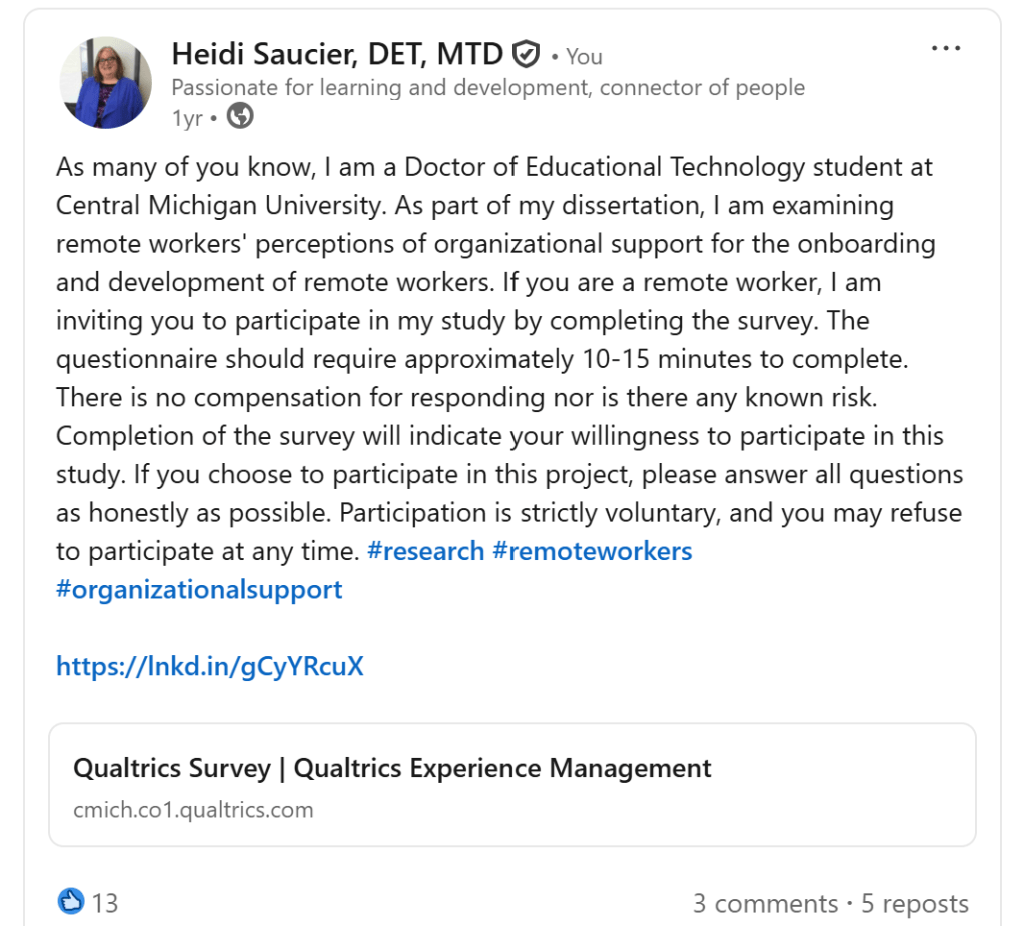
There are various types of samples that can be used for research. There’s random sampling, where individuals are selected unbiasedly like a lottery drawing. Convenience sampling allows the researcher to choose individuals based on their ability to participate and tend to be people that are more easily accessible. Another one of the methods is snowball sampling, which involves people referring others to participate. I chose a convenience sample by soliciting volunteers to complete my survey. I posted on Facebook, LinkedIn, and X asking for people to participate. In each post, there was a link to the survey that included a letter explaining the survey and confirming their participation and that no harm would come to their physical or mental health. I gave participants three weeks to complete the survey. While I was waiting for my data to come in, I worked on literature reviews and sections of my articles that did not rely on my research results. I was excited to see the responses that individuals with experience working from home had and how they related to prior research and my research questions.

Next time, I will share how I evaluated my data and used it to move forward with the writing of two of my three artifacts.

I hope you are enjoying hearing about this journey. I’d love to hear any a-ha moments you’ve had along the way!

Doctoral Journey part 2 – preparing for the dissertation

Last time, I shared highlights of my classroom experiences during my doctoral journey that helped prepare me for my dissertation. Before my research could begin, I had to present my case to the members of my dissertation committee and get their approval. What does that mean?

First, let me explain the dissertation committee. This group was comprised of my program advisor and two faculty members that provided additional insights and support regarding my research. One was well-versed in APA requirements for writing and would be able to ensure I was citing prior research appropriately to prepare me for future publication.

Before I could go before the committee, I had to prepare my dissertation defense. This was a presentation of why I felt there was a need for my research focus, what my research would include, and the timeline for completing my dissertation. I searched for relevant journal articles that provided findings on organizational support and remote workers to support the background of my study and help formulate literature reviews that would correlate with my dissertation artifacts. I created research questions that I would explore through the survey I would later create and identified the research methods I would use for my dissertation.

Part of my proposal also tasked me with considering publications that I would submit each artifact to post-graduation. That allowed me to explore potential journals that would be most appropriate to share my research with.

Once all of this was completed, I presented my proposal to my dissertation committee. This gave the committee the chance to ask questions and clarify what my goals were and the path I wanted to go down for my research. After my presentation, I was excited to learn that my proposal was approved. I was now ready to begin the research path and gather the data I needed for my dissertation.

In my next post, I will share my dissertation adventures and what I learned during that time.

For anyone else that has gone down this path, what were your experiences preparing to start your research? Did  you have to make any adjustments to your dissertation plan? I’d love to hear about it!