Doctoral Journey part 2 – preparing for the dissertation

Last time, I shared highlights of my classroom experiences during my doctoral journey that helped prepare me for my dissertation. Before my research could begin, I had to present my case to the members of my dissertation committee and get their approval. What does that mean?

First, let me explain the dissertation committee. This group was comprised of my program advisor and two faculty members that provided additional insights and support regarding my research. One was well-versed in APA requirements for writing and would be able to ensure I was citing prior research appropriately to prepare me for future publication.

Before I could go before the committee, I had to prepare my dissertation defense. This was a presentation of why I felt there was a need for my research focus, what my research would include, and the timeline for completing my dissertation. I searched for relevant journal articles that provided findings on organizational support and remote workers to support the background of my study and help formulate literature reviews that would correlate with my dissertation artifacts. I created research questions that I would explore through the survey I would later create and identified the research methods I would use for my dissertation.

Part of my proposal also tasked me with considering publications that I would submit each artifact to post-graduation. That allowed me to explore potential journals that would be most appropriate to share my research with.

Once all of this was completed, I presented my proposal to my dissertation committee. This gave the committee the chance to ask questions and clarify what my goals were and the path I wanted to go down for my research. After my presentation, I was excited to learn that my proposal was approved. I was now ready to begin the research path and gather the data I needed for my dissertation.

In my next post, I will share my dissertation adventures and what I learned during that time.

For anyone else that has gone down this path, what were your experiences preparing to start your research? Did  you have to make any adjustments to your dissertation plan? I’d love to hear about it!

Doctoral Journey Part 1 – The Classes

When people hear about a doctoral program, many automatically think of the dissertation. This is the end product of the program, and there are other experiences that take place before a doctoral student embarks on that part of the adventure. For me, I had a series of classes that I was required to take that helped lay the foundation and prepare me for the research and writing that would come.  Today, I’ll share a summary of four classes that were a part of that experience.

Quantitative Research in Educational Technology: This was one of the core courses that prepared me for my dissertation research. My professor was very involved in our learning, providing videos and live demonstrations to guide us through the process of using SPSS, the software that we used to analyze the statistical data we collected. Statistics was not my forte going into the program, but the class helped me practice the true analysis that was to come. I also got a dry run on the topic I had chosen to research, using test questions in my mock survey to see how responses might play out in the future. I learned terms like Chronbach’s Alpha, convenience samples, descriptive analysis, Pearson Correlations, and ANOVA among others. These terms allowed me to find relationships between the data and my survey sample and identify any trends or elements that did not influence the focus of my study. While there were complexities to work through, I found the class very valuable and an insightful part of the overall research process.

Qualitative Research in Educational Technology: Another core course to prepare for dissertation research, the focus this time was on narrative data. We reviewed multiple examples of items that are considered qualitative in nature, and did another test run at collecting data. I chose interviews, video observations, and collateral reviews to tell the story of my research topic. One of the biggest takeaways I gained from this course was learning how to code qualitative data. There are multiple methods to code, from simple post-it notes to software such as Delve that helps you organize your data to identify common themes that tell the story. I also learned the stories of two individuals that had distinctly different experiences related to organizational support working remotely during COVID. While these stories could not be used in my final research, it started to give me ideas of the themes that may emerge when it came time to conduct my dissertation research.

Differentiated Instruction in Online Learning: This class explored options to approach learning in an online environment to address the unique needs of learners. My cohort was a combination of professionals in K-12 education, secondary education, and business learning and development. I appreciated hearing different perspectives on how to approach instruction and gained some insights to consider in the workplace. Learning happened through group discussions, literature reviews, and reflection questions. I came out of the class with ideas to consider implementing in future training courses including reflection activities where learners could identify things they could apply back on the job after completing a course.

Learning Tools in Educational Technology: This course focused on effective use of technology in the virtual and physical classroom. Not only did we explore different learning tools, we were also tasked with considering if technology was appropriate for learning. I was introduced to Neil Selwyn through his book Distrusting Educational Technology: Critical Questions for Changing Times. His views and insights challenged my perspectives on the use of technology in learning and made me think more critically about why technology should be used and the outcomes that should be achieved with a specific technology. I will share my takeaways on that in a future post. I also got to experiment with new technology including Screencast-o-Matic, a platform that allows you to create presentations that include various types of media. Stay tuned for my insights on that and other technology that I explored in the class!

Interwoven between these courses, I prepared for the research and writing that would lead to my dissertation and defense. I met regularly with my advisor for guidance and direction on what I needed to do in order to finalize my research focus and prepare for each step of the process once my classes were completed.

For any of you that have written a thesis or dissertation, what were the highlights of your experience? What classes were the most helpful to you as you prepared for your research and writing?

Next time, I’ll continue with the dissertation journey and what I discovered along the way.

The story behind the research

In the middle of 2020 and 2021, I started considering what I wanted to do next. When I earned my master’s degree in 2016, I thought my college education journey was complete. Now, I was thinking about the possibility of researching something that interested me. At my current company, one of the very first things I was tasked with was to identify how we could offer training classes remotely to the salespeople throughout the state of Michigan. I investigated the technological options, which included WebEx and equipment such as Smart Boards to determine if they would allow easy access and engagement during training classes. In those early days, resources were limited to make this work. About five years later, before my son was born, our company started offering a flexible work arrangement that allowed some employees to work from home a select number of days during the week. I participated in this option, enjoying the balance between time in the office and time at home. Fast forward a few years, and much of the workforce was quickly transitioned to five days a week at home to help prevent the spread of COVID-19.

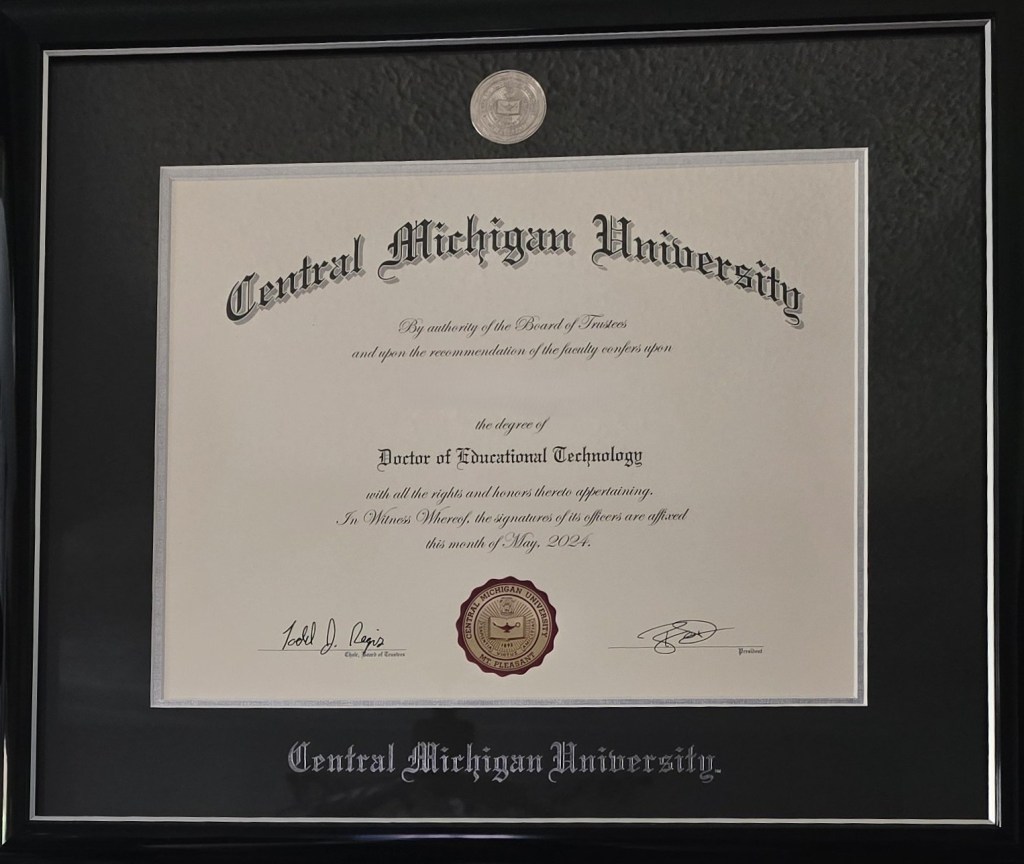
In the workplace, employees need organizational support to be successful. This is how a company demonstrates their commitment to growing and supporting the development needs of their workforce (Saucier, 2024). It can come from the organization, one’s leader, or their coworkers. Navigating through this situation with my coworkers, employees, and friends all over the country, I thought about how we still needed to have this in place and how it was even more important because of losing that physical presence and connection that most perceived as being key to their development needs being met. As I talked to friends about my interest, some suggested that the data I was looking for was being created as we spoke. Feeling inspired, I began to explore universities to find a program that would align with my newfound goal. I discovered that Central Michigan University offered a 100% virtual program to earn a Doctor of Educational Technology degree. Once I went through the application and interview process that led to being accepted into the program, I embarked on an almost three-year adventure of research, learning, and connecting with amazing professionals around the country. On May 3, 2024 (which also happened to be my 48th birthday), I graduated from CMU and officially became “Dr. Sauce.”

What did I discover on this journey? That will be the subject of the next few blog posts as I share the classes I took, the projects that led to some unique opportunities, and how resilience played a key part in my path to the finish line.

References

Saucier, 2024. Exploring perceptions of organizational support for onboarding and development of remote workers. [Unpublished manuscript].

The Return of The Secret Sauce

Almost four years ago, The Secret Sauce was born. It was connected to two goals of mine. First, to run parallel along the early days of my doctoral degree journey where it was used for assignments. Second, to offer a channel that allowed me to live out my mission – To connect people to the tools, resources, people, and experiences to be successful. The site served its purpose for the first goal for a little over a year. As I began to prepare for my dissertation, and major life changes occurred, the site went on a hiatus.

Today, I am excited to return to The Secret Sauce and move forward with continuing my mission. The posts I share with you will come from a variety of areas. Some will center around my research on the perceptions of organizational support for the onboarding and development of remote workers. Even as many organizations have increase the number of days in the office, my findings still apply as there is scenarios where teams are connecting from a variety of locations throughout the workday. Other posts will focus on leadership, learning and development, mentoring, coaching, and unique professional development-related topics. As you visit the site and review the posts, I welcome your feedback and a-ha moments. Have a question you’d like me to tackle? Let me know in the comments and I will add it to my growing list. I look forward to you joining me on this adventure!